
Learning by Labyrinth
A Straight Line is Not Necessarily the Swiftest Path

The Scandal of Luxury in Learning
The modern, efficient approach to learning has been a disaster for the heart. We worship at the altar of efficiency, where communication by text relieves us of the necessity of unnecessary cordiality, where a meal from a sack can be eaten over the sink to reduce clean up time, and where “religion” can be streamed and downloaded to eliminate the “middle-man,” the Church. However, mankind is tenaciously driven by ritual and nourished on liturgical, communal action, where a certain luxury of time, beauty, and poetry are essential. When a face-to-face friendship begins with an invitation to a coffee shop, small talk, eye-contact, mere communication turns into ritual. When a family gathers at the dinner table properly set, says a prayer, and sits together to discuss the day, mere eating transforms into communion. When religion is communion with the faithful and with God in song, accompanied by unnecessary beauty that stirs the senses, then church is elevated to worship. All the best things in life require luxurious waste.
In the award-winning Italian film, Life is Beautiful, the protagonist, Guido, moves to his uncle’s home and is welcomed with a tour of the museum-like vestibule. In every corner of the house are statuary, inventions, furniture, and art. The surfeit of cultural artifacts amazes the nephew who stares with wide eyes. Then the uncle says, “Nothing is more necessary than the unnecessary.” In a movie about the efficiency of the Holocaust, the uncle’s words are poignant.
While the Nazi regime systematically liquidates all the “unnecessary” elements of society—certain books, buildings inhabited by undesirables, and “unproductive” people like the disabled—the Jewish protagonist falls in love with an Italian woman. She is betrothed to a man who sees their marriage as a matter of course. Of course they should marry; they were born on the same street, were educated at the same schools, and share a certain affluent social circle. Meanwhile, the protagonist begins winning her love with all the “unnecessary” elements of relationship: humor, surprise, and, yes, romance. Of course his uncle’s saying applies to relationships, especially to love; nothing is more necessary than the unnecessary.
It is also well said of education: nothing is more necessary than the unnecessary. In the classroom, efficiency is surprisingly inefficient when narrowing lessons to one particular skills-based target turns the banquet of learning into a pill. What is more, such reductionist approaches to education are not efficient. Students do not learn the lessons effectively. A list of reading guide questions and a habit of panning and scanning for answers allows students to “get the right answers” without actually reading the book. Vocabulary lists are limited to 10 words a week, while reading and narrating great literature transforms a child’s vocabulary. What was termed “scientific” learning in the past is now called “data-driven learning” where only what is measurable is a true learning outcome. What cannot be measured? Only the workings of the imagination and the loves of the heart, the very things that make an educated and civilized person.
Examples of education driven by data are perennial and most obvious in the world of standardized testing, especially the famous SAT, ACT, and even the CLT. These high-stakes tests tend to drive the goals, lessons, and assessment styles of even the best classical schools. The outcome of this trend in contemporary education has been to strip the lesson down to a “learning target.” Administrators ask the teachers, “What are they going to get out of this lesson?” or “What are they going to do with this lesson?” revealing the administrator’s conditioning by a love of efficiency.
How does slow, inefficient learning work? Let us make an illustration. A professor once asked his students to find Mark Twain’s obituary. They promptly Googled the data in their efficient phones and found the document in seconds. Then the professor asked the students to descend the dark forgotten, hallowed halls of the library to seek the same information. Even here, the bibliothecary proffered the internet to the students; the keeper of the library was puzzled when the students explained that they were not permitted to use the pixelated screen. So they descended into the basement, and like some heroic journey to the underworld, the students discovered the ancient powers of past ages: microfiche. Imagine what it would mean to uncover and dust off the obituary through this archaic means. To find this text, they would have to know the place of his birth. From there they would have to know, perhaps, the city where he was born, where the local paper would no doubt have published the obituary. When reading the microfiche through the clunky magnifying glass and projection screen, they would see the front page of the day’s newspaper, know what else was happening in the world on that day, and perhaps even encounter advertisements from J. C. Penney with illustrations of the fashions of the times. In short, this “inefficient” approach to finding the document increased the students’ knowledge and enriched their experience more than an efficient Google search that cost them nothing. Efficient education “leaves no scope for the imagination” as Anne of Green Gables would say.
The dominance of efficiency in the classroom has a predictable doom. Why read the entire book, when the “learning target” can be acquired via an excerpt? Why read, when the movie or an AI assistant will answer the question for you? In fact, why are we being educated at all?
In contrast, Dr. Donald Cowan advocates for a restoration of the imagination through redundancy. Perhaps Dr. Donald Cowan needs some introduction. President of The University of Dallas from 1962-1977, Dr. Donald Cowan left a legacy of beauty, taste, and good judgement. He was a physicist who understood that the education of the imagination was the task of all educators.
It is almost impossible to mention Donald Cowan without mentioning his wife, Dr. Louise Cowan who chaired the English Department at The University of Dallas and was dean of graduate studies for decades. I myself had the privilege of seeing her joyful face and hearing her musical voice in lectures on literature and poetry at The Dallas Institute of Humanities and Culture. Of his wife, Donald Cowan said,
“The greatest privilege of the entire experience has been the corporate endeavor—now approaching its half-century mark—shared with a literary scholar, my wife. Only for half a dozen of those fifty years was our work distinct. Most of the time we strove together to discern as much as our different disciplines—literature and physics—would allow. Freely we exchanged ideas and participated in each other’s writings. We could not ourselves identify what phrases of hers are in my work nor mine in hers. This acknowledgment is, then, not dutifully pro forma but a matter of professional integrity.”
Dr. Donald Cowan, in his book on education Unbinding Prometheus, explains that “for genuine learning to take place, instruction must be incomplete, working by synecdoche, leaving gaps that demand completion, transferring the responsibility to the student.” The luxurious approach to education advocated by Dr. Cowan and others like him is shocking to followers of efficiency because the modern connotation of redundancy is excess, superfluidity, repetition, more than enough, unnecessary, and wasteful. However, historically, redundancy comes from the Latin re plus dundare meaning to swell, surge, as a wave. In English redundancy has historically meant copiousness, fullness of being, plenteousness, bountifulness, superabundance, amplification, and overflowing. Cowan warns us that “The modern goals of efficiency and productivity would eliminate this superabundance, not only in production but, more ominously, in education and culture itself.”
Describing redundancy in education, he adds, “The primary imagination must function with a certain plenitude and waste—a redundancy—that tends to scandalize educational administrators [. . .] redundancy, rather than some such guide as Occam’s razor, describes the essential path of the imagination. The very concept of redundancy perhaps needs some rehabilitation in modernity, an age devoted to frugality and efficiency,” thus pointing out that education requires a luxury that is a scandal to many politicians, boards, budgets, parents, and even teachers. However, the luxury of redundancy, the luxury of the imagination, the luxury of friendship, the luxury of pilgrimage, the luxury of a journey through a labyrinth is the only path to the heart where authentic, deep learning takes shape.
Access to the Heart is Not a Straight Line
To see Chartres is to time travel. More accurately, it is to be in the Middle Ages and the Modern day at the same time. Even the stones of the cathedral exist in diverse times. The early gothic and high gothic towers stand side-by-side separated by a hundred years and less than 100 feet. In short, there is a timelessness about the experience.
Those who drew the plans in wax and quarried the stones and chiseled the statuary knew about education of the heart. To enter through the doors is to enter into wonder. The heart reaches out to embrace the mysteries of the cathedral, the people who built it, and the God who it worships. Humility is the appropriate posture when entering this sacred place, and in this state of humility, the heart is ready to receive the memory being passed on through this poem in space.
Let us attend. Let us imagine for a moment that, upon entering the nave, our eyes are drawn up by stained-glass rosy light streaming down from above the gothic pointed arches of the aisles. Then following the path of light, our eyes are led to the stone floor and discover the labyrinth.
We take our first step onto the path of the labyrinth. The pilgrimage has begun. At first, we think we are finding our winding way, until, disoriented, we realize that the labyrinth is leading us.
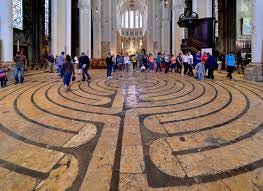
Although the goal is to reach the heart of the labyrinth, the path turns unexpectedly one way and then another. One moment we believe we are near the center, when suddenly the path diverges in a direction that takes us back to the edges of the outer circle, where we are seemingly farther from the goal than ever.
Finally, we relax and enjoy the journey at leisure. Walking the path is the prayer that helps us finally arrive at a place of perception in our own heart. This path to the heart is found primarily (but not exclusively) through the imagination.
If we are considering educating the heart, then we will be educating by labyrinth; the direct path is not the swiftest route. Dr. Cowan explains:
“learning as I conceive it is not a highly efficient operation. It is not a matter of determining which explanation is most direct, what minimum number of experiments need be performed. Instead, a certain richness, a multiplicity of possibilities, a fine excess are required if the imagination is to be instructed properly. At times a mentor must forbid the easy path for his student in order that the surrounding territory be explored.”
How to be Inefficient, Practically Speaking
Cowan was a professor of physics, a man of science, but when asked to suggest what science should be included in the early grades, Cowan replied:
“None. Something much more basic needs to be undertaken before we turn to disciplines and specific content. First the injured imagination [of the image-saturated and data-fed child] needs to be repaired. The child must discover that he possesses a storehouse of images of real things that can be recalled from memory into the active mind, freed of the tags and abstractions by which an efficient environment has short experience of its meaning.”
Leaving time for asking questions that cannot be answered. Writing tests that cannot be graded by a machine. Cultivating discussions that cannot be tied up with a bow. Asking students to discover the geometric proof on their own. Researching bookstacks. Creating space and time for silence and reflection. Showing an unresolved equation with no comment. Requiring a handwritten commonplace book. Memorizing poems by daily recitation. These are lost tools of learning that are very inefficient indeed.
However, above and before all these classroom practices that can wisely slow down learning, a prudent educator will sanctify, that is, set apart, a time and space for learning through ritual. Rituals are embodied in atmosphere, habits, and ideas routinely lived out in the classroom. They are the surest winding path to the heart.
Rituals provide a wardrobe door through which the students can enter Narnia.
The teacher rings a silvery-sounding handbell. The class stands and sings in unison a hymn or recites some thoughtful play. Words are removed from the wall; in their place are pictures with staying-power, great masters of the timeless tradition. The students sit straight with hands folded and feet on the ground because body posture forms our feelings. Uniforms are established on a firm foundation too because how we dress has nothing to do with self-expression; rather our clothes communicate our care for those around us and the tasks we share. Lacking uniforms, skirts, pants, and ties do well. Do the students meet at a table? A tablecloth and simple centerpiece turn a task into a banquet. Are desks set in rows? The clean surface of the desk is ready for a pencil and a book; water bottles and bags are far, far away. The book on the desk, of the timeless tradition, is bound beautifully and filled with ideas that make a heart full. The class ends as it begins, standing and singing in unison to the praise and glory of the King.
The luxurious learning that I propose is not a free-for-all, unschooling, subjective experience after all. The irony is that inefficiency demands self-discipline, self-denial, and formality. Things that efficiency actually strip away.
However, there should be a lot of “waste.” People will feel, “I’m wasting time.” These words kill education of the heart: “We have to get through the material.” Instead, tarry with the work, tarry with the children, and let there be time for them to meet the book, artifact, model, or formula on its own terms, not with the critical eye. Just like meeting a person, it takes time to know an idea.
We must invest in these long, luxurious wasteful moments. These are the best things in life. Exploring nature, reading, building friendships, and prayer are like walking a labyrinth. These long, luxurious, meandering walks should change us. Many wasteful, inefficient, redundancies probably are worth our time. Efficiency is the heart killer.